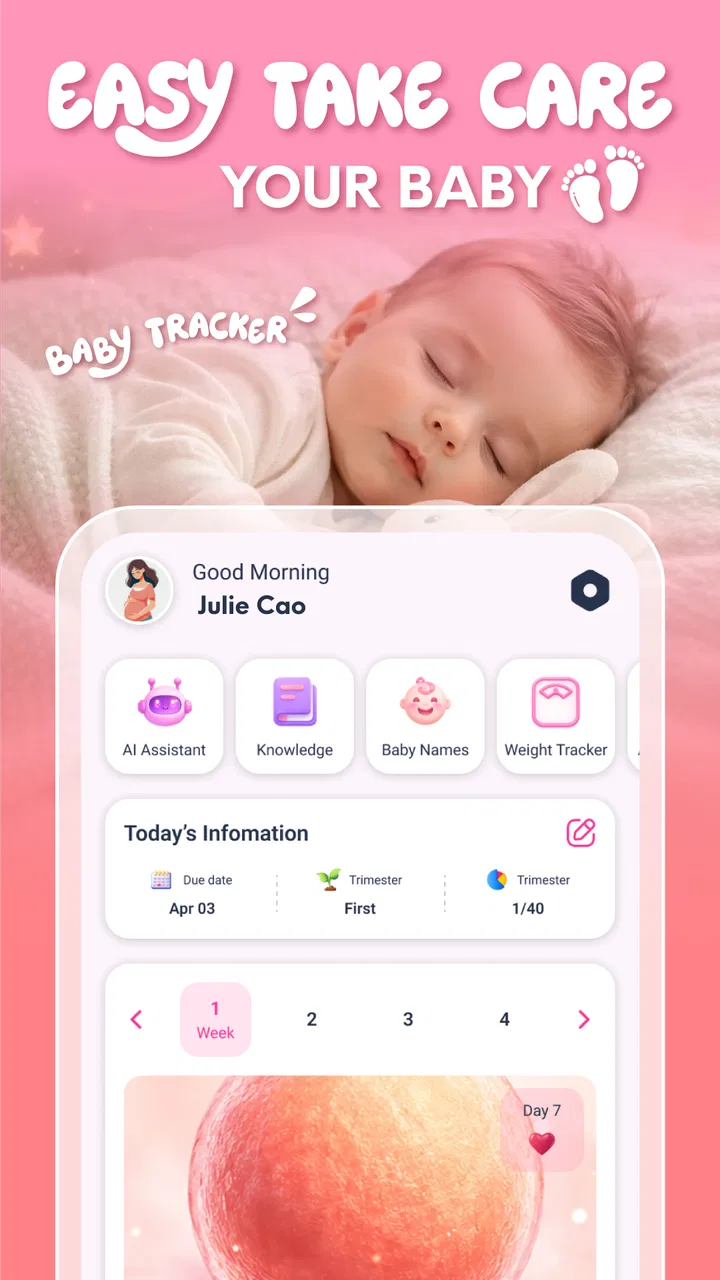
Baby Tracker - Newborn Diary
- 0.0
- Rating
- 10.00K
- Installs
- Free
- Price

 Analysis by App-foxy
Pregnancy turns ordinary days into a long chain of small details: an appointment to remember, a feeling worth noting, a photograph you do not want to lose, and another question that appears just when you thought you had everything organized. Baby Tracker - Newborn Diary is built around that personal side of the journey. I see it as a simple parenting app for recording moments and keeping a running diary, rather than as a replacement for medical care or a complete family-management system.
After spending time with it, my strongest impression is that its value depends on how consistently you use it. The app is most useful when it becomes a quiet habit. A short note after an appointment, a saved memory at the end of a busy day, or a quick entry when something feels especially meaningful can create a record that is much more useful than a scattered collection of phone photos and messages.
It is free, aimed at everyone, and developed by Vu Ha Thi. The current version is 1.0.2 and it runs on Android 7.0 or later. That makes it accessible on many older phones, which is practical for a household device or a spare phone used mainly for family records. The app has passed 10K installs, so it is not an entirely unknown download, although I would still approach it as a focused, relatively lightweight diary rather than a mature platform with a large ecosystem around it.
You May Also Like

 Blood Strike: 2.5 Anniversary
Blood Strike’s Loadouts Turn Every Drop Into a Tactical Gamble
A close look at Blood Strike’s custom loadouts: how fast access to signature weapons reshapes its battle royale rhythm, rewards preparation, and narrows the gap between fights.

 Pandora - Music & Podcasts
Pandora’s Music Is Easy to Start, but Harder to Recover
Pandora’s strength is its low-effort path from a seed to a station. Its weak spot is how much confidence it asks you to place in connection, setup, and quiet recovery.

 8 Ball Pool
 Is Built on Rivalries, Rematches, and Routine
A close look at the rivalries, rematches, shared routines, and unanswered safety questions that turn a quick pool match into a persistent mobile community.

 Samsung Music
’s Quiet Strength Is Playing What You Already Own
Its reach comes less from spectacle than from dependable access to a personal library. That simplicity is both the app’s strongest retention engine and its ceiling.

 AccuWeather: Weather Radar
AccuWeather Review: A Quick, Clear Forecast for Everyday Decisions
For everyday plans, the best forecast is the one you can understand quickly. AccuWeather makes rain timing, radar, and local conditions easy to act on, with a few trade-offs.

 Hill Climb Racing
Why Hill Climb Racing Still Turns Crashes Into One More Run
A tiny car, a bumpy hill and one more upgrade: Hill Climb Racing keeps resurfacing because its simple chaos makes every near-miss feel personal.
More From Our News Desk
View All News


How it fits into a shared household routine
The easiest way to understand this app is to imagine a normal evening at home. One parent has just returned from an appointment, the other is preparing dinner, and neither person wants to reconstruct the day from memory later. Opening the diary to save a brief note or a special moment takes less effort than sending several messages and hoping they remain easy to find. Used this way, the app becomes a shared point of reference for the emotional and personal side of pregnancy.
That scenario also shows where expectations need to stay realistic. I would not treat it as a live coordination board for a household. The confirmed purpose is tracking the pregnancy journey, saving memories, and following special moments. Those are valuable jobs, but they are different from assigning tasks, managing appointments for several people, or maintaining a detailed schedule for relatives.
For a couple, the best routine may be to decide that one person records the formal notes while both contribute memories. That avoids duplicate entries and keeps the diary from becoming a second inbox. If you use a shared phone, agree on a simple naming habit for entries. A date followed by a short description can make older memories easier to recognize than vague labels such as “today” or “important.” This is a small workflow choice, but it matters once the diary starts to grow.
I also like the idea of using it between major milestones, not only on appointment days. A first reaction to an ultrasound image, a new food preference, a funny conversation, or a moment of reassurance may seem too minor to record at the time. Later, those details often carry more emotional weight than the formal timeline. The app’s memory-focused approach gives those moments a proper home instead of leaving them buried in a camera roll.
Start with a narrow purpose instead of trying to record everything
My practical advice is to choose two kinds of entries at the beginning: useful journey notes and personal memories. Useful notes might help you remember what you discussed or what you want to ask next time. Personal memories are for the parts you will want to revisit. Separating those intentions mentally prevents the diary from becoming an exhausting attempt to document every hour.
This is one of the app’s less obvious trade-offs. A pregnancy diary can feel intimate and rewarding, but it can also become another responsibility if you turn it into a perfect archive. I found the concept more appealing when treated as a selective record. A few honest lines are better than a complicated routine that gets abandoned after a week.
Households should also decide whether the app belongs on a personal phone or a shared device. A personal phone is more convenient for spontaneous entries, while a shared device can make participation easier for both parents. The second option may be useful when one person does not want the diary tied to their own phone, but it requires a clear habit: return the device to the same place, keep the app easy to find, and avoid mixing private notes with unrelated household activity.
Setup boundaries and what I would keep outside the diary
Baby Tracker - Newborn Diary presents itself as an app for following a pregnancy journey and preserving memories. I would therefore set it up as a personal record from the first day, not as the single source of truth for health decisions. Medical instructions, medication details, urgent symptoms, and professional advice should remain in the channels provided by a qualified clinician. A diary can help you remember what happened; it should not be used to decide what treatment is appropriate.
That boundary is especially important because a memory entry and a medical record serve different purposes. A diary may capture how you felt, what you noticed, or what you wanted to ask. A clinician needs accurate context and may need information presented in a particular way. If you use the app to jot down questions before an appointment, treat the note as a prompt for conversation rather than a diagnosis.
I would also avoid putting every household responsibility into it. Shopping lists, transport arrangements, childcare planning, and appointment reminders may be better handled by tools designed for those tasks. Trying to force all of them into a pregnancy diary can make the main experience harder to use. The app’s strength is its personal continuity, not its ability to replace every shared calendar or messaging thread.
Before inviting a partner to use the app, agree on what should be visible on the device. A shared phone changes the privacy context even when everyone involved trusts each other. One person may want to record an emotional reflection that is not meant for casual viewing, while another may prefer to keep entries practical. The safest household approach is to discuss those boundaries before the first shared entry, rather than discovering the difference after a sensitive note has been saved.
Because the app is free, it is easy to try without making a financial commitment. That lowers the barrier for households that only want a basic journal. It does not remove the need to think about the value of the information being stored, though. I would keep the diary focused, avoid copying unnecessary personal details into every entry, and make a habit of checking important information through the appropriate professional source.
A useful two-layer workflow for couples
One workflow stood out to me as particularly sensible. Use the diary for the shared story, and keep a separate, clearly identified place for questions that need professional follow-up. For example, a short diary entry can describe a memorable day, while a separate note outside the app can hold questions to raise at the next appointment. This prevents emotional memories from being mixed with information that needs a more formal review.
A second helpful habit is to write entries while the event is still fresh, but keep them brief. A sentence about the moment, a sentence about how it felt, and a reminder of what you want to remember later is enough. This approach makes the app realistic for a busy household. It also reduces the risk that one parent becomes the unpaid archivist while everyone else simply expects a complete record to appear.
If several people use the same phone, I would add a simple author convention inside the text, such as beginning with “I” or identifying who made the note. This is not a built-in family feature; it is just a practical household method. Without it, memories from different people can blur together over time. The small effort pays off when you reread the diary months later.
Coordination without confusing a diary with a family control center
The app can support coordination indirectly because shared memories give a couple a common timeline. One person can record an appointment-related moment, and the other can add their own perspective later. That creates continuity without requiring a long conversation every time. For couples who live apart temporarily or have different work schedules, this kind of asynchronous participation can be more comfortable than trying to talk through every detail immediately.
Still, I would not assume that both people are working from a synchronized account or that the app provides family roles, invitations, or controlled access. Those details should not be treated as part of the experience unless they are clearly available in the app itself. My recommendation is to plan around the simplest confirmed use: the person holding the device opens the diary and records the moment, while the other person contributes when they have access.
This matters in a household with grandparents or other relatives. Sharing selected memories can be lovely, but I would make the decision manually rather than assuming the app is designed for a wider family network. If a relative needs a specific update, a direct conversation may still be better. The diary can preserve the story for the household; it does not automatically become a broadcast channel.
The same distinction applies to devices. If you move from one phone to another, do not assume that every entry will appear automatically or that the diary is intended to serve as a multi-device family workspace. Before relying on it for irreplaceable memories, I would test the way you plan to use it and keep personal copies of especially important photographs or notes in a place your household already trusts.
That may sound cautious for a simple app, but pregnancy memories are difficult to recreate. A diary can be emotionally important even when it is technically modest. My rule would be straightforward: use the app for convenient daily recording, but do not let it be the only place where a once-in-a-lifetime photograph or essential appointment detail exists.
When another type of app is the better choice
If your main goal is symptom analysis, medical guidance, or detailed week-by-week education, a dedicated pregnancy health app may suit you better. If your priority is feeding, sleep, diaper, or newborn-care logging after birth, a specialized baby-care tracker will probably offer a more appropriate structure. If your household needs assignments, reminders, and shared schedules, a family organizer is the clearer choice.
Baby Tracker - Newborn Diary makes more sense when the goal is personal continuity: remembering how the journey felt, preserving meaningful moments, and keeping a simple record that can be revisited. That narrower purpose is not a weakness by itself. In fact, it may be exactly why someone avoids a larger pregnancy app filled with charts and prompts they do not intend to use.
The trade-off is that a focused diary may require more discipline from the user. A specialized tracker often guides you with predefined fields, while a memory-oriented app depends more on what you choose to write. For me, that freedom is pleasant when I want to capture something unusual, but less helpful when I am looking for a structured checklist or a precise daily log.
Age context, trust, and responsible use
The Everyone content rating makes sense for a pregnancy and parenting diary intended for general audiences. The subject is family-oriented, and there is no reason to approach it as an entertainment app with an age-specific audience. Even so, the rating should not be confused with a guarantee that every household will want every entry visible to every person using the device.
Trust in this context is mostly about household habits. A partner may be comfortable sharing practical notes but not private feelings. A child who occasionally uses the same tablet may not need access to the diary at all. A relative helping with the phone may see the app accidentally. These situations do not require complicated rules, but they do require awareness that a family device is not the same as a private notebook.
I would explain the app’s role clearly to anyone who joins the routine: it is a place to preserve memories and follow the journey, not a medical authority and not a substitute for speaking with a professional. That explanation is useful even with trusted adults because it prevents a casual diary note from being treated as a definitive health update.
For older household members who are less comfortable with apps, simplicity is an advantage. They can contribute a short memory when the phone is available without learning a large family platform. On the other hand, if they need reliable access to appointments or urgent information, I would use a more direct method. The diary is best for reflection and continuity, not time-critical coordination.
Parents should also think about the child who will eventually read the diary. Writing with future rereading in mind can change the tone of an entry. I found it more meaningful to describe a moment honestly than to create a polished record that sounds like a public announcement. The app works best when it keeps the family’s real voice, including ordinary days that would otherwise disappear.
Small habits that make the record more valuable
One useful technique is to include context that a photograph cannot show: what made the moment special, who was present, or what you were looking forward to next. Another is to record the reason an entry matters rather than only the event itself. “We went to an appointment” is functional, but “we felt relieved after hearing the answer to our question” preserves the emotional meaning.
I would also avoid writing only on milestone days. The contrast between a major event and an ordinary afternoon can make the diary feel like a real story rather than a checklist. A short entry once in a while is enough. The goal is not volume; it is recognizability. When you return to the record later, you want to remember the atmosphere of the period, not just the dates.
Finally, review the diary occasionally with your partner and decide whether it still reflects the boundaries you agreed on. A household’s comfort can change during pregnancy. Something that felt fine to share at the beginning may feel more personal later. Treating the diary as a living family record, rather than a permanent public archive, encourages more thoughtful use.
My household verdict after using it
I would recommend Baby Tracker - Newborn Diary to someone who wants a straightforward place for pregnancy memories and does not need a large collection of medical tools or family-management functions. The free price makes experimentation easy, the Everyone rating keeps its intended audience broad, and support for Android 7.0 or later means it can work on older household phones as well as newer ones.
Its best quality is its focus. Instead of asking you to manage every part of family life, it gives you a reason to pause and preserve the moments that are easy to lose. That makes it a good companion for a couple who wants to build a shared story gradually, especially when one person records entries at different times from the other.
I would skip it if you expect a full medical tracker, a synchronized family planner, or a newborn-care log with specialized categories. I would also be cautious about making it the sole home for irreplaceable memories until I had established a backup routine that suited my household. Those limitations do not cancel out its value; they define the kind of value it offers.
For me, the right way to use it is deliberately modest: record meaningful moments, keep health decisions with professionals, agree on what belongs on a shared device, and preserve the most important memories in another trusted place as well. Used within those boundaries, Baby Tracker - Newborn Diary feels less like another demanding parenting tool and more like a small personal archive for a life-changing season.
The developer, Vu Ha Thi, has kept the idea easy to understand, and the app’s current version, 1.0.2, is suitable for trying the basic diary approach without paying first. I would not choose it for complex coordination, but I would suggest it to a friend who wants to remember the journey in their own words. The real strength is not recording everything; it is making the moments you choose to save easier to find and revisit.
FAQs for Baby Tracker - Newborn Diary
01What is Baby Tracker - Newborn Diary used for?
Baby Tracker - Newborn Diary is designed to help parents record and organize everyday information about a newborn. You can typically log feeding sessions, bottle amounts, diaper changes, sleep periods, pumping, growth measurements, medication, and other childcare notes. Having these details in one place makes it easier to recognize routines and share useful information with a partner, babysitter, or pediatrician during appointments.
02Is Baby Tracker - Newborn Diary suitable for breastfeeding and bottle-feeding?
Yes, the app is intended to support different feeding routines, including breastfeeding, bottle-feeding, pumping, and combination feeding. Parents can record relevant details such as the start and end of a nursing session, the breast used, bottle quantity, or pumping output, depending on the available tracking options. This can be particularly helpful during the early weeks, when feeding patterns change frequently.
03Can multiple caregivers use the same Baby Tracker account?
Baby Tracker - Newborn Diary is most useful when everyone caring for the baby can access the same information. Depending on the version and platform, the app may offer synchronization or sharing features that allow parents and caregivers to update a common record across devices. Before downloading, check the current listing for details about account requirements, supported devices, and whether synchronization is included for free.
04Does Baby Tracker - Newborn Diary provide medical advice or diagnose problems?
No. Baby Tracker - Newborn Diary should be treated as a record-keeping and organization tool, not as a replacement for a doctor, midwife, or other qualified healthcare professional. Charts, reminders, and recorded statistics can help you describe your baby’s routine, but they cannot determine whether a symptom is serious. Contact a healthcare provider whenever you have concerns about feeding, sleep, diapers, growth, fever, or behavior.
05Is Baby Tracker - Newborn Diary free to download, and does it contain in-app purchases?
The app may be available to download at no initial cost, but some features can depend on the edition, operating system, or optional in-app purchases. Premium tools may include expanded reports, additional tracking categories, synchronization, customization, or an ad-free experience. Pricing and included features can change, so review the Google Play or App Store page carefully before installing and confirm any subscription terms shown during setup.
Pros
- Quickly logs feeds
- diapers
- sleep
- pumping
- and growth measurements.
- Clear daily timeline makes it easy to spot routines and changes.
- Useful reminders help parents keep track of upcoming care tasks.
- Multiple caregivers can share updates and stay synchronized.
- Reports and charts provide helpful information for pediatrician visits.
Cons
- Some useful features may require a premium subscription.
- Frequent tracking can feel time-consuming during exhausting newborn days.
- Data entry may become repetitive when caring for multiple children.
- Shared access depends on reliable internet and account synchronization.
- Parents must review entries carefully to avoid logging events incorrectly.

Baby Tracker - Newborn Diary
Gallery